Showing posts with label Civil War. Show all posts

Saturday, May 16, 2020

Captain Thomas Leonard


Originally published on Blogger 2/9/2012 
A revised and expanded version of this story appears in 
Snapshots and Short Notes, Kenneth Wilson, Univ. of North Texas Press, 2020.


Some of the research on this card had already been done for me by Chris Warner of Kansas, the previous owner of this real photo postcard.  The image is of a handsome couple in front of their house in Austin, Minnesota, on the Fourth of July, 1911.  As you can see the old Civil War veteran is wearing his Grand Army of the Republic ribbon and his reunion hat (1) with the GAR emblem sits on his knee.  His wife stands beside him, and the house is decorated with flags and banners to celebrate the holiday.

The card is addressed to Miss Mattie J. Lang, Austin, Minnesota, and its handwritten message reads, "We wish you a happy birthday and many returns of July 4th," and is signed, "Mr. & Mrs. Leonard." A seemingly later note was written on the back: "Mr. & Mrs. Leonard were next-door neighbors in Austin to Grandma and Grandpa Lang, Aunt Mattie and Aunt Minnie Lang." 

With a magnifying glass or the magic of the computer, you can make out the details of the ribbon that Mr. Leonard is wearing.  Here is a detail of that part of the photo:


The ribbon reads, "In Memoriam, McIntyre Post 66, Austin, Minnesota," and above is the symbol of the Grand Army of the Republic medal.


Captain Leonard was born in 1842 and died in 1916, five years after the above photo was taken. He is buried in the Oakwood Cemetery in Austin, Minnesota, and a picture of his grave monument is available at www.findagrave.com.

Thomas Leonard enlisted in Vermont in 1861 as a private into F Company, 3rd Infantry (Vermont), and was mustered out in 1865.  He was promoted to sergeant (date unknown) to 2nd. Lieutenant in 1864, 1st Lieutenant, and Captain in 1865.  

Leonard apparently saw considerable action during the war because he is listed as having been wounded on July 10, 1863, at Funkstown, MD, and again at the Battle of the Wilderness on May 6, 1864, and again only six days later at Spotsylvania Court House, Virginia, on May 12, 1864.

The following three paragraphs, compliments of Wikipedia, give some brief details of these three Civil War engagements:

The Battle of Funkstown occurred near Funkstown, Maryland, on July 10, 1863, during the Gettysburg Campaign. Union forces of the Army of the Potomac attacked the rear guard of the Confederate Army of Northern Virginia during its retreat from Pennsylvania following the Battle of Gettysburg.  Maj. Gen. J.E.B. Stuart’s cavalry, posted at Funkstown, posed a severe risk to the Union army. Stuart was determined to wage a spirited defense to ensure Lee time to complete the fortifications protecting his army and his avenue of retreat.  Gen. John Buford’s Union cavalry division encountered Stuart’s crescent-shaped, three-mile-long battle line.  By early evening, the Union Army began withdrawing, and Stuart had kept the Federals at bay for yet another day.  The day-long battle resulted in 479 casualties. 

The Battle of the Wilderness, fought May 5–7, 1864, was the first battle of Lt. Gen. Ulysses S. Grant's 1864 Virginia Overland Campaign against Gen. Robert E. Lee and the Confederate Army of Northern Virginia. Both armies suffered heavy casualties.

The Battle of Spotsylvania Court House was the second major battle in Lt. Gen. Ulysses S. Grant's 1864 Overland Campaign.  Following the bloody but inconclusive Battle of the Wilderness, Grant's army disengaged from Confederate General Robert E. Lee's army. It moved to the southeast, attempting to lure Lee into battle under more favorable conditions. Elements of Lee's army beat the Union army to the critical crossroads of Spotsylvania Court House and began entrenching. Fighting occurred on and off from May 8 through May 21, 1864, as Grant tried various schemes to break the Confederate line. Ultimately, the battle was tactically inconclusive, but with almost 32,000 casualties on both sides, it was the costliest battle of the Overland campaign.

Captain Leonard would undoubtedly have had some harrowing stories to tell, and although those details have been lost to us, this wonderful real photo postcard and the notes on the back of it connect us to his life in a very real way.

If you know more about Captain Leonard's history or that of his neighbors, the Lang family, please add your comments to the blog or email me.


In war, there are no unwounded soldiers. 
 –– José Narosky


1. The Grand Army of the Republic was a Civil War veterans' organization formed in 1866. GAR posts formed in many towns and cities where members gathered for camaraderie. Leonard's hat was the regulation uniform hat of the organization and would have been worn at GAR meetings, Civil War parades, memorials, and reunions.


Postcard sent to the Adjutant of GAR Post 257, Drakesville, Iowa, circa 1897, 


Dodge City, Kansas GAR Reunion, 1910. 

Veteran seated at right is wearing GAR uniform hat.


1906 Postcard.


Sunday, July 14, 2013

Rude Words for a True American Hero


Originally published Breadcrumbs Blogger post 7/14/2013 
A revised and expanded version of this story appears in 
Snapshots and Short Notes, Kenneth Wilson, Univ. of North Texas Press, 2020. 


This impromptu photograph of Dr. Mary Edwards Walker, circa 1912, was almost certainly snapped without her consent on a sidewalk in New York, and no doubt Dr. Walker had very sharp words for the photographer. Despite the circumstances of its creation, the photo gives us a candid look at one of the more intriguing characters in American History. The image is printed on a real photo postcard and discourteously titled “Dr. Mary Walker, The Only Self Made Man in America.” 
 
You will note that Dr. Walker is dressed in trousers and a top hat. When this photograph was taken, that had been her chosen mode of dress for many years. Born in Oswego, New York, in 1832 to very progressive or “free-thinker” parents who believed strongly in education and equality for women, Mary became an early advocate for women’s rights and dress reform, and she rejected the tight-fitting, restrictive women’s clothing of the day.
 
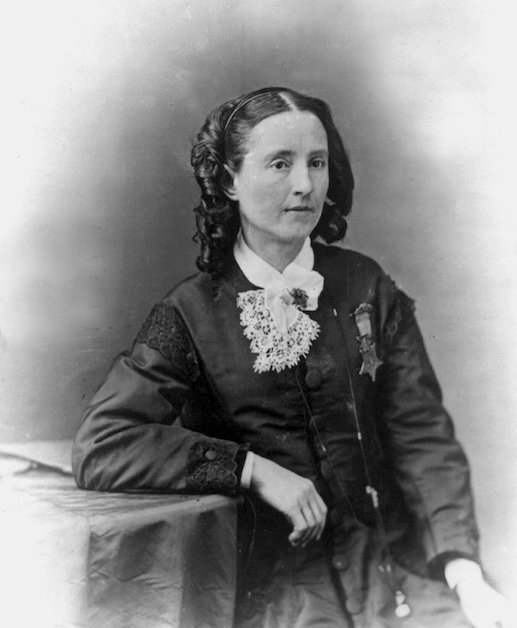
Mary Walker's story goes well beyond her choice of attire. She was a physician, abolitionist, women's rights activist, and Civil War surgeon. She was the first female surgeon in the U.S. Army and the only female recipient of the Congressional Medal of Honor, the United States’ highest military honor, awarded for personal acts of valor above and beyond the call of duty.  
 
Walker graduated from medical school in 1855 at age 23, when very few women in the country were medical doctors. She married and began a medical practice; however, the marriage ended in divorce, and in 1861, when the Civil War broke out, Walker volunteered her services as a physician to the Union Army. The army refused her a commission or a salaried position because of her gender. Despite this rejection, Walker volunteered her services and worked long, arduous, unpaid hours, first as a nurse and later as a field surgeon in tent hospitals near the battlefront. She treated wounded soldiers at the First Battle of Bull Run in 1861 and later that year at the Battle of Fredericksburg.  


Walker continued requesting an official posting as a surgeon, but the army refused her a commission. Though officially a nurse, she wore the green sash of an army physician as she worked alongside the male doctors. A New York Tribune article written about Dr. Walker in 1862 included this paragraph:


Dressed in male habiliments… she carries herself amid the camp with a jaunty air of dignity well calculated to receive the sincere respect of the soldiers… She can amputate a limb with the skill of an old surgeon and administer medicine equally as well. Strange to say that, although she has frequently applied for a permanent position in the medical corps, she has never been formally assigned to any particular duty.


In response to her many requests for a position as a physician, President Lincoln sent a letter to Dr. Walker in 1864, which read in part:


The Medical Department of the army is an organized system in the hands of men supposed to be learned in that profession and I am sure it would injure the service for me, with strong hand, to thrust among them anyone, male or female, against their consent.


In September of 1863, in Chattanooga, Tennessee, Walker treated the wounded after the Battle of Chickamauga, where Assistant Surgeon General Robert Wood observed her work and later assigned Walker the rank of Acting Assistant Surgeon. During these years, Walker continued to face the disapproval of many of the male physicians who had little respect for her opinions, including her suggestion that many of the battlefield amputations were unnecessary. Despite these conflicts, there is ample evidence that many physicians and generals in the field were grateful for her assistance in treating large numbers of wounded.
 
In 1862, Walker wrote to the War Department, requesting employment with the Secret Service as a Union spy, but this offer was declined. There is some speculation that, subsequently, she actually worked as a spy in Confederate territory, but the validity of those claims is apparently in question.
 

As an acting assistant surgeon to the 52nd Ohio Volunteers in 1864, Walker managed a hospital for women prisoners and an orphanage. Part of her responsibility included caring for the surrounding civilian population, and she often crossed enemy lines in performing this duty. On one of these excursions, Walker was captured and arrested as a spy by Confederate troops and imprisoned at the notoriously brutal Castle Thunder Prison in Richmond, Virginia, until her release later that year as part of a prisoner exchange. After her release from prison, Walker cared for Confederate women prisoners and an orphan asylum in Louisville, Kentucky.


Walker modified her uniforms during military service to include trousers and a knee-length tunic. She faced adverse reactions from male physicians and female patients, who were offended by her manner of dress and believed that women should not be doctors. 
 
After the Civil War, Congress awarded Walker the Congressional Medal of Honor for meritorious service. However, in 1917, in an unfortunate twist of fate, Congress rescinded Walker’s medal and those of 910 other recipients, including "Buffalo Bill" Cody, when the Medal of Honor standards were revised to include only awards for actual combat. Despite this ruling, Walker wore the medal proudly until her death in 1919. In 1977, congress restored Walker's medal posthumously, citing her "distinguished gallantry, self-sacrifice, patriotism, dedication and unflinching loyalty to her country, despite the apparent discrimination because of her sex."
 
Walker continued to work and lecture for women’s rights and dress reform well into her later years. In September 1866, she helped Susan B. Anthony and Lucy Stone organize the Women’s Suffrage Association for Ohio. She was also a powerful spokesperson for the Temperance Movement and was quite outspoken on the evils of sexual activity beyond the act of procreation. Walker attempted to vote in 1872 and continued to fight for the right of all women to vote and the abolishment of slavery. She campaigned for a U.S. Senate seat in 1890 and became a well-known figure of her time, easily recognized by her formal attire, including a winged collar and top hat. Unfortunately, Walker was often ridiculed for this manner of dress and even harassed by children on the street.
 
Dr. Mary Walker died in Oswego, New York, at 86.  During WWII, a Liberty ship, the SS Mary Walker, was named for her, and in 1982, the US Postal Service issued a 20¢ stamp honoring Dr. Walker. In 2012, a statue of her likeness was erected in Oswego. The bronze figure depicts young Dr. Walker wearing trousers under her uniform skirt and proudly wearing the Medal of Honor. A quote from Walker is inscribed on the lectern that accompanies the statue: 
 

“I have got to die before people will know who I am and what I have done. It is a shame that people who lead reforms in this world are not appreciated until after they are dead; then the world pays its tributes.”


Dr. Mary Edwards Walker was a dynamic figure with unyielding views on many subjects. She was undoubtedly eccentric and perhaps complex and antagonistic. Still, she was a person of fervent convictions who fought tirelessly for the causes she believed in–abolishing slavery and improving medical treatment, education, and women's rights. You might disagree about her views on temperance, but in her honor, let’s raise a glass of a non-alcoholic beverage and proclaim, “Here’s to Mary Edwards Walker, a vigorous and genuine American hero!”


9/20/2022 Addendum:

From “A History Lesson for Trump: Transgender Soldiers Served in the Civil War” by Steve Hendrix, Washington Post, August 25, 2017:

https://www.washingtonpost.com/news/retropolis/wp/2017/07/26/a-history-lesson-for-trump-transgender-soldiers-served-in-the-civil-war/


Many cross-dressers and gender defiers have served in the U.S. military since its earliest days. In fact, cross-dressing soldiers have been in the ranks of armies at least as far back as Joan of Arc, the 15th-century military genius who was burned at the stake for heresies that included wearing a man’s uniform.


During the American Civil War, boys just barely past puberty served in both armies, and the smooth face of a female impostor could easily have passed without remark.

“Researchers at the National Archives have found evidence that at least 250 women dressed as men to fight in the 1860s, some motivated by ideology, some by a taste for adventure, and some by the need for a job. Most of those who survived presumably returned to their lives as women, but others continued to live as men after the war.”  


Sources and Additional Reading: 


Women in Military Service for America Memorial:  

            https://womensmemorial.org/

Changing the Face of Medicine:  

            http://www.nlm.nih.gov/changingthefaceofmedicine/physicians/biography_325.html 

Obscure Histories, Mary Edwards Walker: 

            https://www.obscurehistories.com/dr-walker-resource-links

Mary Walker's Quest to be Appointed as a Union Doctor in the Civil War by Alexis Cole, The Atlantic, Feb. 7, 2013:

            http://www.theatlantic.com/sexes/archive/2013/02/mary-walkers-quest-to-be-appointed-as-a- union-doctor-in-the-civil-war/272909/

Walker Bio:

            http://www.biography.com/people/mary-walker-9522110

Women in History:

            https://www.womenshistory.org/education-resources/biographies/mary-edwards-walker

Dedication of Walker statue in Oswego, NY 

             http://www.syracuse.com/news/index.ssf/2012/05/statue_to_dr_mary_edwards_walk.html

Castle Thunder:

             http://en.wikipedia.org/wiki/Castle_Thunder_(prison) 


D Frenzel July 16, 2013 at 8:28 AM

Thanks, Ken. Interesting post (as always). Dave Frenzel.


Anonymous December 11, 2013 at 12:31 PM

Hey Ken...I've been to her grave (so what else is new). Rumor has it that she was buried with her Medal of Honor, so they couldn't get it back from her....Ginny Michaels