Saturday, December 28, 2013

More Than a Game

People ask me what I do in winter when there's no baseball. 
I'll tell you what I do. I stare out the window and wait for spring. 
– Rogers Hornsby

A few years ago, I found an old, broken, worn-out Little League baseball bat in the corner of an antique shop. The bat is a late 1940s or early 1950s Louisville Slugger 125J, Little League model, with a Babe Ruth decal.  The bat had been badly broken, split along the grain, but the break had been carefully repaired. The first repair was probably done with black electrician’s tape judging by the tape residue still on the bat. The second repair was done by tightly wrapping the broken area with steel wire. To say that the bat spoke to me is to use a well-worn cliché, but it spoke to me.


“Label up! Hold the bat with the label up!” Most kids who learned to play baseball in the era before aluminum bats can remember those instructions shouted at them as they hefted the bat at home plate and looked toward the pitcher. The bat in their hands would have been made from ash or oak, and the “label” was more than likely not actually a paper label or decal, but a manufacturer’s trademark branded into the wood. The child knew what the instructions meant, even if he didn’t know why; the maker’s name and emblem should be facing up.

Here’s a picture of the “label” on the Babe Ruth bat, and below it is an example of how it would have looked when it was new:


Before the mid-nineteenth century, baseball players were expected to provide their own bats, and many sizes and shapes of bats were in use. As the game became more organized, rules were imposed to limit the bat diameter and length, although the shapes varied, including some bats with flat hitting surfaces. Bats with rounded barrels soon became the norm, but no matter what the size or shape, wooden bats were still subject to being broken during the course of a ballgame.

The contact between a pitched ball and the bat is an exceptionally violent collision, and occasionally a wooden bat breaks at the moment of impact––usually splitting along the grain of the wood. The best safeguards against breaking a bat are the choice of a strong, close-grained wood for its construction and striking the ball with the edge of the wood's grain rather than the side of the grain. The manufacturers of wooden bats place their trademarks or labels with the alignment of the wood grain in mind; if the label is facing up, the edge of the grain is toward the incoming ball. (1)

The history of Louisville Slugger baseball bats begins with a broken bat. In 1884 Pete Browning, the star player for the Louisville Eclipse baseball team, broke his favorite bat during a game, and Bud Hillerich, the son of a local woodworker, offered to make him a new one. Bud’s father, J. F. Hillerich, owned a shop that produced stair railings, porch columns, and butter churns. Using his father's shop, seventeen-year-old Bud turned a new bat for Mr. Browning, who proceeded to get three hits with it the next day. 

Young Hillerich persuaded his father to add baseball bats to their product line, and they trademarked the name “Louisville Slugger” in 1894. While there have been other manufacturers of wooden baseball bats, the Louisville Slugger has been the best-known wooden baseball bat for well over a century. Frank Bradsby became a partner in the business in 1916, and the firm’s name was changed to The Hillerich and Bradsby Company. By 1923, the company was the largest manufacturer of baseball bats and over the years, baseball legends like Honus Wagner, Rogers Hornsby, Babe Ruth, Lou Gehrig, Jackie Robinson, Ted Williams, Hank Aaron, and Derek Jeter have all swung Louisville Sluggers. 

Broken baseball bats are only useful as kindling for a fire and are usually discarded. However, as with most things, necessity sometimes trumps convenience––and that was the case with our 125J Louisville Slugger.  

One can envision the events unfolding as a dejected child held a broken bat that had seen many days of hard play on the baseball diamond.  The evidence clearly shows an attempted mending with black tape, possibly performed by the child, and a later wound-wire repair likely done by a father, an uncle, or an older friend.


The story this bat tells is one about the time and effort spent to repair it and to convince a child that it was still usable and that a new bat was simply out of reach––at least for the time being; it puts us in a precise moment of generosity and affection as well as sharing lessons of perseverance, problem-solving, and frugality. 


The wear on this bat demonstrates that it was used for a considerable amount of time after the repair was completed. One can imagine the emotions of the child changing from those of distress to grudging acceptance and perhaps even to a smile of delight as the bat went back into play and the game went on.

A Louisville 125J, with the Babe Ruth decal in very excellent condition is apparently worth several hundred dollars to collectors. I get that, but I'd rather have this bat––it tells a better story.

“Use it up – wear it out – make it do” is an old adage that we don’t hear or observe much anymore, at least not in the more prosperous parts of the world, but it’s a good lesson to keep in mind––if you want to win the big game. 


Link to the history of the Louisville Slugger:
http://slugger.com/story/history.html
Link to video about The Hillerich and Bradsby Company:
https://www.youtube.com/watch?v=jroExgSSjzo
Link to Rogers Hornsby bio, National Baseball Hall of Fame:
Link to Babe Ruth bio, National Baseball Hall of Fame:
  1. To understand the physics behind the impact between the baseball and the wooden bat, hold a deck of playing cards in your hand and strike a surface with the flat of the cards and notice how the deck flexes and bends.  Now strike with the edge of the deck and notice how differently the cards react. The individual cards represent the grain of the wood, and in this position, much more force is transmitted into the blow. Not only will more force be transmitted to the baseball, but the possibility that the bat will flex and break will be greatly diminished.
Personal note:  
My great-uncle, Texas Grey Burleson, was eight years older than Rogers Hornsby. They both grew up on the Blackland Prairie of Texas in a large bend of the Colorado River known as Hornsby Bend, just east of Austin. Rogers Hornsby went on to great fame as a professional baseball player in the years between 1915 and 1937. As the family legend goes, Uncle Grey was also a very good baseball player, and he also wanted to leave home to play baseball, but was told by his father that baseball was only a game for children.  He soon left home for work as a cowboy in Wyoming, where he married our Aunt Ollie and where they had a wonderful life together.

Rogers Hornsby is buried in his family's cemetery at Hornsby Bend, Texas. Texas Grey Burleson, a favorite fellow in our family, is buried alongside Ollie Burleson, in Buffalo, Wyoming.


Friday, July 19, 2013

Lone Ranger Rides Again – a story about a ranger and his bear, as told/sold on eBay Dec. 2008

A copy of my eBay description for an item I sold online in 2008 follows: I am putting the story up on the blog just for fun.  The Lone Ranger and his fuzzy bear are long gone to a new home, so don't send emails offering me large sums of money for him.  I apologize for the images.  These were photographed long ago and had to be resurrected by the magic of computer technology from an old Word document where they were low-resolution files in a rich text format, which was, in reality, not so rich.


Okay, at first glance, you might think, "Hey, The Lone Ranger is Riding a Bear!"  You would be correct, but that's not the whole story...

I know you can still hear the stirring music from the radio or the black-and-white TV and the announcer saying, "... the daring and resourceful masked rider of the plains led the fight for law and order in the early West. Return with us now to those thrilling days of yesteryear... The Lone Ranger Rides Again!" (Remember the word resourceful.)


Just before the scene opens, the Lone Ranger is sitting astride his fiery horse, Silver, awaiting the return of his trusty Indian (PC apologies) companion, Tonto.  Tonto had ridden into town with orders to skulk around looking for bad guys who were rumored to be planning a hostile takeover of the local home mortgage lender.

As you will recall, Silver was a "fiery" horse and, with the speed of light and in a cloud of dust, Silver made a quick crow-hop to avoid an empty peanut butter jar thrown out of a covered wagon, leaving the Lone Ranger "sittin' on nothin', way up in the air," as the old cowboy song goes.

Well, LR landed pretty hard and realized the jarring thump had stirred his bladder, and he really needed to wet down the dust of the West. 

So... modestly facing an arroyo wall, pistols in hand just in case, he was heeding the call when a black bear came around the corner and thought he looked just like a river salmon!


Lone detected the bear's approach, and with lightning reflexes honed by years of trying to keep his white ranger suit clean in the dusty, dusty Wild West, he turned to face his foe, pistols still in hand.


The bear turned right around, thinking, "Whoa! A man with a mask? What's up with that? Halloween was months ago!  How does he keep that suit so clean? And how did he zip up with a pistol in each hand?"  

While the bear was preoccupied with these "bearzarre" thoughts, LR got the drop on him and hopped (no, not HOPPY -- that's another western––stay with us) on the bear's back, and rode him to a stand-still!


As he sat on the bear, several thoughts went through the Ranger's head.  The first was, "Where the heck is Silver?" The second thought was, "Wow, this furry seat is really comfy on my butt!" The third was, "As a matter of managerial protocol, should I be sitting lower than my trusty companion, Tonto, on his pony, Paint?"  After brief consideration, he shrugged and muttered to himself, "Oh, well, we can catch a prairie dog for Tonto to ride as soon as he gets back from town." 

"A fuzzy bear with the speed of grandma, a few small puffs of dust, and a hearty Hi-Yo, Fuzzy! The Lone Ranger!  With his faithful Indian companion, Tonto (riding Little Sparky), the daring and resourceful masked rider of the plains...  The Lone Ranger rides again!"

Tune in again next week, but until then, this small plastic Lone Ranger figure and plastic bear will be up for grabs.  LR is 2 & 1/2" tall and 2" wide.  Condition is good, with some light wear from play.  Fuzzy is 2" long and in similar condition. He has "Made in Hong Kong" branded on his belly.  How he got out west, I'll never know. They have been riding together on my bookcase for about 20 years.

Good Luck!

The thoughts of youth are long, long thoughts.
–– Henry Wadsworth Longfellow

Sunday, July 14, 2013

Rude Words for a True American Hero


Originally published Breadcrumbs Blogger post 7/14/2013 
A revised and expanded version of this story appears in 
Snapshots and Short Notes, Kenneth Wilson, Univ. of North Texas Press, 2020. 


This impromptu photograph of Dr. Mary Edwards Walker, circa 1912, was almost certainly snapped without her consent on a sidewalk in New York, and no doubt Dr. Walker had very sharp words for the photographer. Despite the circumstances of its creation, the photo gives us a candid look at one of the more intriguing characters in American History. The image is printed on a real photo postcard and discourteously titled “Dr. Mary Walker, The Only Self Made Man in America.” 
 
You will note that Dr. Walker is dressed in trousers and a top hat. When this photograph was taken, that had been her chosen mode of dress for many years. Born in Oswego, New York, in 1832 to very progressive or “free-thinker” parents who believed strongly in education and equality for women, Mary became an early advocate for women’s rights and dress reform, and she rejected the tight-fitting, restrictive women’s clothing of the day.
 
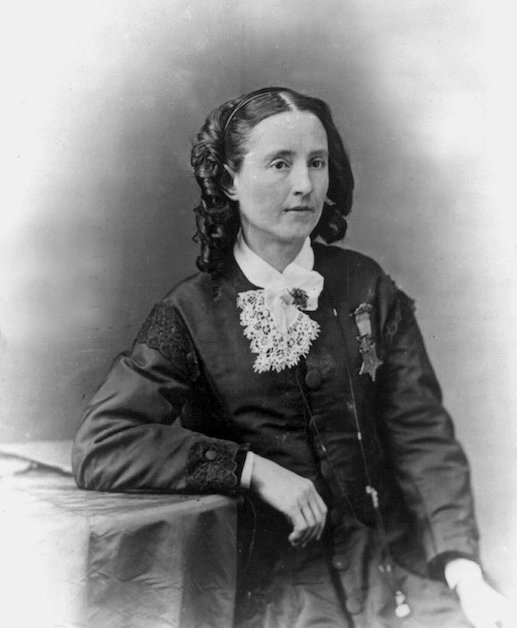
Mary Walker's story goes well beyond her choice of attire. She was a physician, abolitionist, women's rights activist, and Civil War surgeon. She was the first female surgeon in the U.S. Army and the only female recipient of the Congressional Medal of Honor, the United States’ highest military honor, awarded for personal acts of valor above and beyond the call of duty.  
 
Walker graduated from medical school in 1855 at age 23, when very few women in the country were medical doctors. She married and began a medical practice; however, the marriage ended in divorce, and in 1861, when the Civil War broke out, Walker volunteered her services as a physician to the Union Army. The army refused her a commission or a salaried position because of her gender. Despite this rejection, Walker volunteered her services and worked long, arduous, unpaid hours, first as a nurse and later as a field surgeon in tent hospitals near the battlefront. She treated wounded soldiers at the First Battle of Bull Run in 1861 and later that year at the Battle of Fredericksburg.  


Walker continued requesting an official posting as a surgeon, but the army refused her a commission. Though officially a nurse, she wore the green sash of an army physician as she worked alongside the male doctors. A New York Tribune article written about Dr. Walker in 1862 included this paragraph:


Dressed in male habiliments… she carries herself amid the camp with a jaunty air of dignity well calculated to receive the sincere respect of the soldiers… She can amputate a limb with the skill of an old surgeon and administer medicine equally as well. Strange to say that, although she has frequently applied for a permanent position in the medical corps, she has never been formally assigned to any particular duty.


In response to her many requests for a position as a physician, President Lincoln sent a letter to Dr. Walker in 1864, which read in part:


The Medical Department of the army is an organized system in the hands of men supposed to be learned in that profession and I am sure it would injure the service for me, with strong hand, to thrust among them anyone, male or female, against their consent.


In September of 1863, in Chattanooga, Tennessee, Walker treated the wounded after the Battle of Chickamauga, where Assistant Surgeon General Robert Wood observed her work and later assigned Walker the rank of Acting Assistant Surgeon. During these years, Walker continued to face the disapproval of many of the male physicians who had little respect for her opinions, including her suggestion that many of the battlefield amputations were unnecessary. Despite these conflicts, there is ample evidence that many physicians and generals in the field were grateful for her assistance in treating large numbers of wounded.
 
In 1862, Walker wrote to the War Department, requesting employment with the Secret Service as a Union spy, but this offer was declined. There is some speculation that, subsequently, she actually worked as a spy in Confederate territory, but the validity of those claims is apparently in question.
 

As an acting assistant surgeon to the 52nd Ohio Volunteers in 1864, Walker managed a hospital for women prisoners and an orphanage. Part of her responsibility included caring for the surrounding civilian population, and she often crossed enemy lines in performing this duty. On one of these excursions, Walker was captured and arrested as a spy by Confederate troops and imprisoned at the notoriously brutal Castle Thunder Prison in Richmond, Virginia, until her release later that year as part of a prisoner exchange. After her release from prison, Walker cared for Confederate women prisoners and an orphan asylum in Louisville, Kentucky.


Walker modified her uniforms during military service to include trousers and a knee-length tunic. She faced adverse reactions from male physicians and female patients, who were offended by her manner of dress and believed that women should not be doctors. 
 
After the Civil War, Congress awarded Walker the Congressional Medal of Honor for meritorious service. However, in 1917, in an unfortunate twist of fate, Congress rescinded Walker’s medal and those of 910 other recipients, including "Buffalo Bill" Cody, when the Medal of Honor standards were revised to include only awards for actual combat. Despite this ruling, Walker wore the medal proudly until her death in 1919. In 1977, congress restored Walker's medal posthumously, citing her "distinguished gallantry, self-sacrifice, patriotism, dedication and unflinching loyalty to her country, despite the apparent discrimination because of her sex."
 
Walker continued to work and lecture for women’s rights and dress reform well into her later years. In September 1866, she helped Susan B. Anthony and Lucy Stone organize the Women’s Suffrage Association for Ohio. She was also a powerful spokesperson for the Temperance Movement and was quite outspoken on the evils of sexual activity beyond the act of procreation. Walker attempted to vote in 1872 and continued to fight for the right of all women to vote and the abolishment of slavery. She campaigned for a U.S. Senate seat in 1890 and became a well-known figure of her time, easily recognized by her formal attire, including a winged collar and top hat. Unfortunately, Walker was often ridiculed for this manner of dress and even harassed by children on the street.
 
Dr. Mary Walker died in Oswego, New York, at 86.  During WWII, a Liberty ship, the SS Mary Walker, was named for her, and in 1982, the US Postal Service issued a 20¢ stamp honoring Dr. Walker. In 2012, a statue of her likeness was erected in Oswego. The bronze figure depicts young Dr. Walker wearing trousers under her uniform skirt and proudly wearing the Medal of Honor. A quote from Walker is inscribed on the lectern that accompanies the statue: 
 

“I have got to die before people will know who I am and what I have done. It is a shame that people who lead reforms in this world are not appreciated until after they are dead; then the world pays its tributes.”


Dr. Mary Edwards Walker was a dynamic figure with unyielding views on many subjects. She was undoubtedly eccentric and perhaps complex and antagonistic. Still, she was a person of fervent convictions who fought tirelessly for the causes she believed in–abolishing slavery and improving medical treatment, education, and women's rights. You might disagree about her views on temperance, but in her honor, let’s raise a glass of a non-alcoholic beverage and proclaim, “Here’s to Mary Edwards Walker, a vigorous and genuine American hero!”


9/20/2022 Addendum:

From “A History Lesson for Trump: Transgender Soldiers Served in the Civil War” by Steve Hendrix, Washington Post, August 25, 2017:

https://www.washingtonpost.com/news/retropolis/wp/2017/07/26/a-history-lesson-for-trump-transgender-soldiers-served-in-the-civil-war/


Many cross-dressers and gender defiers have served in the U.S. military since its earliest days. In fact, cross-dressing soldiers have been in the ranks of armies at least as far back as Joan of Arc, the 15th-century military genius who was burned at the stake for heresies that included wearing a man’s uniform.


During the American Civil War, boys just barely past puberty served in both armies, and the smooth face of a female impostor could easily have passed without remark.

Researchers at the National Archives have found evidence that at least 250 women dressed as men to fight in the 1860s, some motivated by ideology, some by a taste for adventure, and some by the need for a job. Most of those who survived presumably returned to their lives as women, but others continued to live as men after the war.  


Sources and Additional Reading: 


Women in Military Service for America Memorial:  

            https://womensmemorial.org/

Changing the Face of Medicine:  

            http://www.nlm.nih.gov/changingthefaceofmedicine/physicians/biography_325.html 

Obscure Histories, Mary Edwards Walker: 

            https://www.obscurehistories.com/dr-walker-resource-links

Mary Walker's Quest to be Appointed as a Union Doctor in the Civil War by Alexis Cole, The Atlantic, Feb. 7, 2013:

            http://www.theatlantic.com/sexes/archive/2013/02/mary-walkers-quest-to-be-appointed-as-a- union-doctor-in-the-civil-war/272909/

Walker Bio:

            http://www.biography.com/people/mary-walker-9522110

Women in History:

            https://www.womenshistory.org/education-resources/biographies/mary-edwards-walker

Dedication of Walker statue in Oswego, NY 

             http://www.syracuse.com/news/index.ssf/2012/05/statue_to_dr_mary_edwards_walk.html

Castle Thunder:

             http://en.wikipedia.org/wiki/Castle_Thunder_(prison) 


D Frenzel July 16, 2013 at 8:28 AM

Thanks, Ken. Interesting post (as always). Dave Frenzel.


Anonymous December 11, 2013 at 12:31 PM

Hey Ken...I've been to her grave (so what else is new). Rumor has it that she was buried with her Medal of Honor, so they couldn't get it back from her....Ginny Michaels